Advertisements
When the Ocean Fights Back (With Robots!)
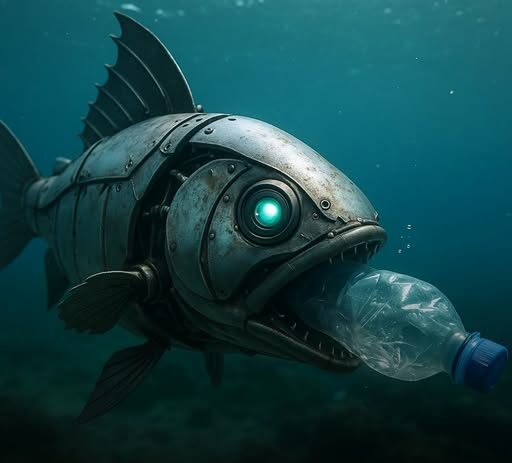
You’ve probably seen videos of beaches covered in plastic bottles or sea turtles tangled in bags. It’s heartbreaking, right? Now imagine a fish—not a real one, but a robot—swimming around and actually eating that plastic to power itself. Sounds like science fiction? Well, researchers in the UK just turned it into science fact.
Scientists at the University of Surrey have unveiled a “cyborg fish” that cleans the water while fueling itself on pollution. No batteries. No wires. Just a clever way of using waste to keep swimming.
Why This Matters for Our Planet
Plastic pollution is one of the biggest threats to marine life. Millions of tons of plastic end up in oceans every year, breaking down into microplastics—tiny bits so small that even fish, birds, and humans end up consuming them.
Now, instead of seeing plastic as a deadly problem only, this robotic fish shows us that pollution could become part of the solution.
Step 1: Meet the Cyborg Fish
Not your usual robot.
This robotic fish is built with a special microbial fuel cell. That’s like a mini stomach filled with bacteria that can digest microplastics and turn them into electricity.
- It swims like a real fish.
- It powers itself with no external energy.
- And it keeps working as long as there’s plastic around.
Benefit: It cleans while it moves—double win for the environment.
Example: Think of it like a vacuum cleaner that doesn’t need charging because it runs on the very dust it collects.
Step 2: How It Powers Itself
Goodbye batteries, hello bacteria.
Instead of plugging into a charger, this robot uses a bio-battery where microbes eat plastic particles. As they break them down, they release electrons—basically creating an electrical current. That electricity then powers the robot’s tiny fins and sensors.
Benefit: A sustainable, eco-friendly robot that doesn’t rely on lithium or fossil fuels.
Step 3: Cleaning While Swimming
Every move has a purpose.
As the robot moves through polluted waters, it “feeds” on microplastics, reducing the waste floating around. That means cleaner water for marine life and less plastic entering the food chain.
Example: Imagine if thousands of these robotic fish were deployed in rivers before plastics ever reached the ocean.
Step 4: The Bigger Picture of Eco-Robotics
Beyond just a cool invention.
This project isn’t just about one robotic fish. It’s about rethinking how we design sustainable technology. Instead of depending on harmful resources, machines could one day:
- Eat waste for energy
- Repair ecosystems as they work
- Reduce our carbon footprint naturally
Benefit: A future where robots don’t add to pollution, but actively fight it.
The Challenges Ahead
Of course, it’s not all smooth swimming.
- These robots are still in the early stages.
- Scaling them for oceans will take more time and funding.
- Scientists need to ensure they don’t accidentally harm marine life while cleaning.
But the potential is massive.
Quick Checklist: Why This Matters
- ✅ Cleans up microplastics in oceans
- ✅ Runs on renewable, self-sustaining energy
- ✅ Reduces dependency on harmful fuels
- ✅ Opens doors for eco-friendly robotics
- ✅ Turns pollution into power
FAQ: Cyborg Fish & Plastic Pollution
Q1: Who created the cyborg fish?
Researchers at the University of Surrey in the UK.
Q2: How does it get power?
It uses a microbial fuel cell that digests plastic and turns it into energy.
Q3: Is it already in use in oceans?
Not yet. Right now, it’s being tested in controlled environments before scaling.
Q4: Can this robot solve ocean plastic pollution alone?
No. But combined with better waste management and recycling, it could be a powerful tool.
Advertisements