Advertisements
At first glance, the Eastern Coral Snake and the Florida Scarlet Snake look almost identical. Both species have bright red, black, and yellow markings that make them eye-catching and easy to confuse. But here’s the big difference: one is venomous and potentially dangerous, while the other is harmless.
Knowing how to tell them apart is not only fascinating but also important for safety. Let’s break down the banding patterns and other key features that can help you distinguish the two.
Meet the Snakes
🟥 Eastern Coral Snake (Micrurus fulvius)
- Venomous, belongs to the Elapidae family.
- Found across Florida and much of the southeastern United States.
- Recognizable for its bright rings that wrap completely around the body.
- Possesses a powerful neurotoxic venom (though bites are rare).
🟦 Florida Scarlet Snake (Cemophora coccinea)
- Harmless, non-venomous colubrid.
- Native to the southeastern U.S., especially Florida.
- Small, secretive, and mostly nocturnal.
- Known for its similar red, black, and pale/yellowish bands.
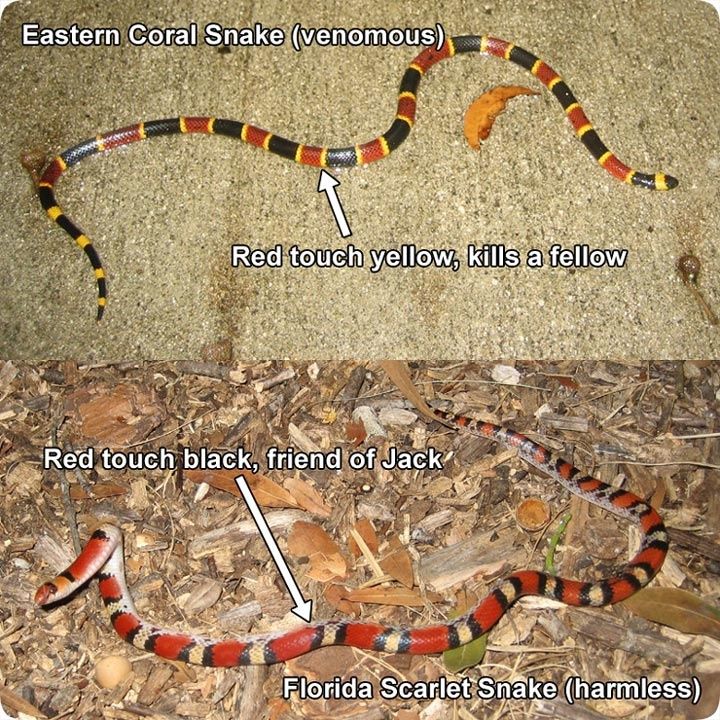
The Famous Rhyme: “Red Touch Yellow, Kill a Fellow…”
One of the most common ways people learn to tell these snakes apart is through the rhyme:
👉 “Red touch yellow, kill a fellow. Red touch black, friend of Jack.”
Here’s what it means:
- If red and yellow bands are touching, you’re likely looking at a coral snake (venomous).
- If red and black bands are touching, it’s usually a scarlet snake (nonvenomous).
⚠️ Important Note: This rhyme is a useful rule of thumb for North America, but it doesn’t apply to coral snakes in other regions (like Central and South America).
Key Banding Pattern Differences
- Coral Snake (Venomous)
- Red bands always touch yellow bands.
- Bands are clean and form full rings around the body, including the belly.
- Head and snout are typically black.
- Scarlet Snake (Harmless)
- Red bands are separated from yellow/pale bands by black.
- Red often touches black instead of yellow.
- Bands may not fully encircle the belly; they appear more like “saddles.”
- Snout is usually red or reddish.
Quick Identification Tips
- ✅ Check the snout: Black snout = coral snake; red snout = scarlet snake.
- ✅ Look at the belly: Full rings = coral snake; incomplete bands = scarlet snake.
- ✅ Banding sequence: Red touching yellow = venomous; red touching black = harmless.
Why the Confusion?
Bright colors in nature are often a warning sign, and the scarlet snake benefits from this mimicry. By looking like a dangerous coral snake, the scarlet snake deters predators—a classic case of Batesian mimicry.
Safety First
- If you’re unsure which snake you’ve encountered, do not attempt to handle it.
- Coral snake bites are rare, but they are medically significant and require urgent treatment.
- Always observe snakes from a safe distance, and appreciate their beauty without putting yourself at risk.
Final Thoughts
The Eastern Coral Snake and Florida Scarlet Snake are strikingly similar at first glance, but a closer look at their banding patterns, snout color, and belly markings reveals the truth.
Remember:
- Red touch yellow → venomous coral snake.
- Red touch black → harmless scarlet snake.
By keeping this simple rule in mind, you can safely admire both species while respecting the important role they play in nature.
Advertisements