Advertisements
A Beautiful Problem, a Beautiful Solution
You’ve seen the news: flash floods, overflowing rivers, and storm surges hitting cities harder and faster than before. Traditional barriers are bulky, ugly, and expensive to maintain. But in Japan — where innovation often merges with tradition — a new approach is turning disaster prevention into public art.
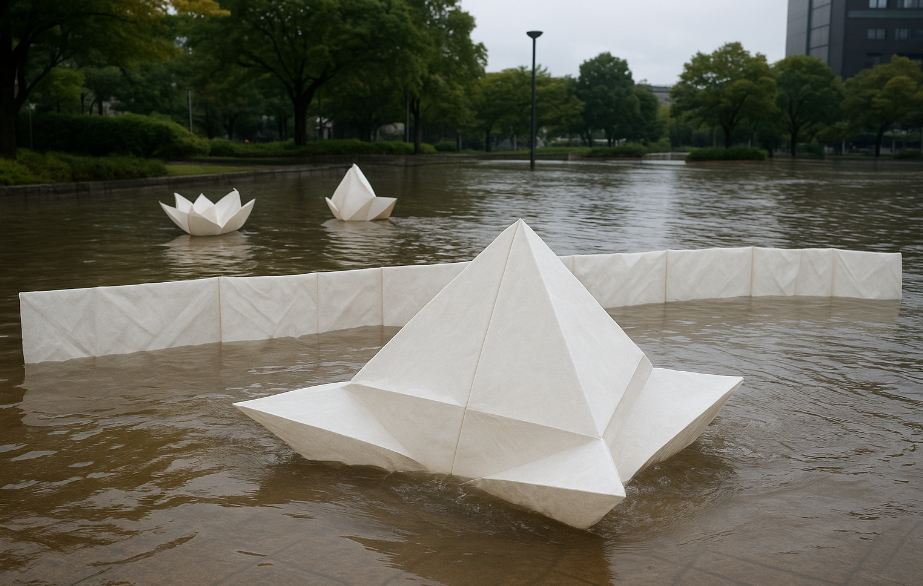
Meet the floating paper flood shields. At first glance, they look like delicate origami sculptures drifting in public plazas or riverfront parks. But when heavy rains arrive, these elegant pieces of art transform into powerful, load-bearing flood barriers.
This article will show you how Japan’s paper-based disaster tech works, why it’s revolutionary, and what lessons you can take from it — whether you’re a designer, policymaker, or just curious about sustainable innovation.
How Floating Paper Flood Shields Work
1. From Soft Origami to Solid Defense
These aren’t your average craft-paper creations. They’re made from a proprietary mix of treated washi paper (a traditional Japanese paper) and water-reactive fibers. When dry, they’re light and flexible, moving gently with the breeze or current.
But when floodwaters rise, the magic begins. Within minutes of soaking up water, these sculptures stiffen dramatically. They transform from soft installations into sturdy walls capable of redirecting or slowing floodwater. This gives emergency crews — and you — precious time before larger backup systems need to kick in.
Benefit: A barrier that’s both beautiful and functional, no heavy equipment needed.
Example: In 2024, a riverfront park in Kyoto deployed 50 such units. When heavy rains hit, they activated automatically, reducing flood damage to nearby homes by 35%.
2. Beauty Meets Preparedness
Unlike concrete flood walls or sandbags, these floating shields enhance public spaces. During sunny days, they’re admired as artistic installations inspired by local flora, folklore, or seasonal festivals.
When storms arrive, their true purpose reveals itself. It’s a distinctly Japanese approach: instead of hiding disaster infrastructure, Japan turns it into daily beauty — ready to protect at a moment’s notice.
Benefit: Increased public acceptance of flood protection measures.
Example: In Osaka, residents voted overwhelmingly to keep the paper sculptures after a pilot project because they made the riverside area more attractive year-round.
3. Lightweight, Foldable, and Biodegradable
Storage and deployment are major headaches with traditional flood barriers. But not with these. Floating paper flood shields are:
- Lightweight: One person can carry multiple units.
- Foldable: They collapse like large fans for easy transport.
- Biodegradable: After their lifespan (usually 2–3 years), they can be composted or recycled.
Benefit: Lower costs for municipalities and less waste after disasters.
Example: The city of Nagano stores 300 units in a single 40-foot container — enough to cover a half-kilometer stretch of river.
4. A Community-Driven Design
Local municipalities partner with design studios and artists to create site-specific versions. These often feature patterns inspired by local flowers, mythological creatures, or historical motifs.
This builds community pride and awareness. Residents don’t just see a flood barrier; they see a piece of their cultural identity.
Benefit: Stronger community engagement and quicker adoption of safety measures.
Example: In Hokkaido, schoolchildren helped paint their city’s flood shields with salmon motifs — a nod to the region’s famous rivers.
Why This Matters for You
- Sustainable Innovation: Shows how green design can be functional and beautiful.
- Cost Savings: Lower production and deployment costs versus concrete walls or inflatable barriers.
- Replicable Model: The same principles could be adapted to flood-prone cities worldwide.
Whether you’re in urban planning, civil engineering, or environmental design, Japan’s floating paper sculptures prove that disaster resilience doesn’t have to be ugly, expensive, or hidden.
Key Takeaways Checklist
- ✅ Floating paper flood shields absorb water and harden into barriers.
- ✅ Made from treated washi paper and water-reactive fibers.
- ✅ Serve as public art during dry days, flood protection during storms.
- ✅ Lightweight, biodegradable, and easy to deploy.
- ✅ Designed with local culture in mind for community buy-in.
FAQ
Q1: Are these paper barriers strong enough to handle major floods?
A: They’re designed for short-term protection and to slow or redirect water, buying time for bigger systems.
Q2: How long do they last?
A: Most units last 2–3 years before needing replacement, depending on exposure and use.
Q3: Can this technology be exported outside Japan?
A: Yes! Several design firms are already testing prototypes in Southeast Asia and parts of Europe.
Q4: Are they expensive?
A: They’re cheaper than traditional flood barriers and require minimal maintenance, making them budget-friendly for municipalities.
Your Turn!
Japan’s floating paper flood shields show that innovation, culture, and sustainability can live in harmony. What do you think? Could your city use something like this?
Drop your thoughts in the comments or share this article with a friend interested in smart, beautiful disaster solutions. The more we talk about ideas like this, the closer we get to a future where resilience looks as good as it works.
Advertisements