Advertisements
The Ultimate Hard Drive Is Inside You: How DNA Data Storage Changes Everything
Your Hard Drive is Doomed (And That’s a Problem)
You know that sinking feeling. The spinning wheel of death. The dreaded “click of death” from a hard drive that’s given up the ghost. We’ve all been there.
We’re creating more data than ever—family photos, work documents, that massive movie collection. But our best storage tech? It’s shockingly fragile. Hard drives crash after a decade. SSDs have a finite number of writes. Magnetic tape degrades. And those “cloud” servers? They’re just someone else’s computer in a massive, energy-hungry building.
We’re facing a digital dark age, where our most precious memories and vital knowledge could simply vanish into a puff of silicon.
But what if I told you the solution to this massive data storage problem has been inside every living thing on Earth for billions of years? What if the perfect storage device was biology itself?
The Future of Data Isn’t Silicon. It’s Biological.
I’ve been fascinated by the intersection of biology and technology for years. And after digging into the research from giants like Microsoft and the ETH Zurich, I’m convinced: DNA data storage isn’t just science fiction. It’s the next frontier.
And the best part? The core concept is incredibly simple to understand. I’m going to break down how this mind-blowing technology works and why it will soon be the ultimate data storage solution for everything from your family albums to the entire global digital archive.
How Does DNA Data Storage Actually Work? (It’s Simpler Than You Think)
Think of DNA as nature’s oldest and most efficient software. Instead of the binary code of 0s and 1s that computers use, DNA uses a four-letter chemical code: A (Adenine), T (Thymine), C (Cytosine), and G (Guanine).
The process of storing data in DNA is a brilliant act of translation. Here’s how it works in three simple steps:
- Translation: Specialized software takes the binary code (0s and 1s) of a digital file—be it a text document, JPEG, or MP4—and translates it into a sequence of A, T, C, and G. It’s like converting a book from English into a secret, molecular language.
- Synthesis: This designed DNA sequence is then sent to a machine that chemically synthesizes (creates) the corresponding DNA strand in a lab. This synthetic DNA strand contains your file.
- Storage & Retrieval: The newly created DNA is dried down or placed in a cool, dark container, where it can sit, stable, for millennia. When you want your data back, you use a standard DNA sequencer (the same kind used in genetics labs) to “read” the strand. Software then reverses the process, translating the A, T, C, G back into perfect binary code.
A Real-World Example That Will Blow Your Mind
In a landmark 2016 project, researchers encoded and retrieved a whopping 200 megabytes of data. What did they save?
- The entirety of Shakespeare’s 154 sonnets
- A classic silent movie (“The Arrival of a Train at La Ciotat”)
- A pioneering academic paper on genetics
- Even a full $50 Amazon gift card (which was successfully redeemed after decoding!)
And the physical space all this data took up? The DNA holding it was smaller than a single grain of sand.
The Unbeatable Benefits of DNA as a Storage Medium
Why go through all this trouble? Because DNA smashes every other storage technology out of the water.
Mind-Boggling Density
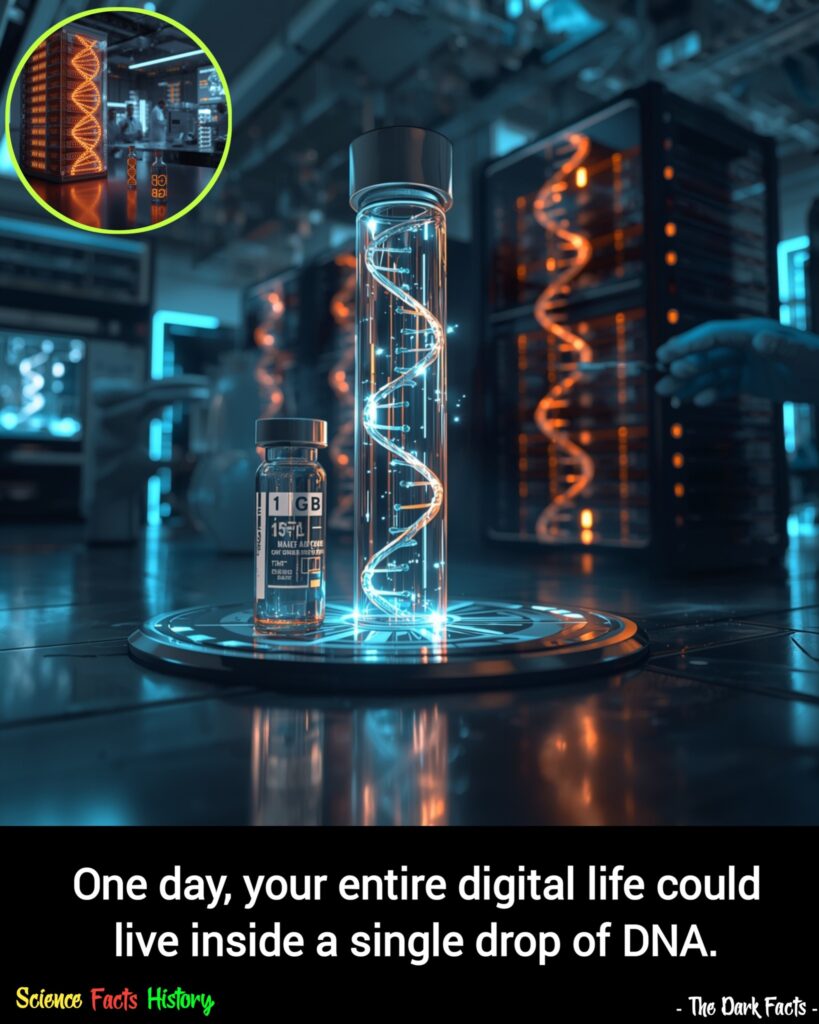
This is the big one. The data density is almost incomprehensible. A single gram of DNA can theoretically hold 215 petabytes (215 million gigabytes) of data. Let that sink in.
Your entire music collection? A flick of a strand. The Library of Congress? Fits in a sugar cube. Some estimates suggest the world’s entire digital archive—every YouTube video, every Instagram post, every satellite image—could be stored in the back of a van. This solves the biggest problem of the digital age: physical space.
Astounding Longevity
Hard drives degrade. CDs get scratched. But DNA? We’ve successfully sequenced DNA from woolly mammoths that are over 10,000 years old. When stored in a cool, dark place (like a vault), DNA can preserve data for tens of thousands of years with zero energy input. It’s the ultimate cold storage solution and time capsule for human civilization.
Universal Relevance
As long as we understand genetics (and we always will), we will have the technology to read DNA. You won’t need a legacy SCSI controller or a floppy disk drive from the 90s. The fundamental “code” and the machines to read it will never become obsolete.
Who’s Leading the Charge? It’s Not Just Sci-Fi.
This isn’t just happening in a lone academic’s lab. A DNA data storage market is emerging, backed by serious players.
- Microsoft is perhaps the most invested, with its Microsoft Research Lab demonstrating fully automated systems for writing and reading DNA. They’re building a DNA-based hard drive prototype.
- Startups like Catalog in Boston are innovating on the synthesis process, aiming to make it faster and cheaper to “write” data.
- Researchers are even going a step further, experimenting with storing data inside the DNA of living organisms, like bacteria. Imagine a future where the tree growing in your garden literally contains your family’s digital photo album.
So, What’s the Catch? The Hurdles to Overcome
It’s not all smooth sailing. For DNA data storage to become a mainstream data storage solution, two major hurdles need to be overcome:
- Speed: The processes of writing (synthesizing) and reading (sequencing) DNA are currently slow compared to blinking a file onto an SSD. We’re talking hours or days, not milliseconds.
- Cost: While the cost of DNA sequencing has plummeted (thanks to companies like Illumina), synthesizing custom DNA strands is still expensive. It costs thousands of dollars to encode even a few megabytes of data.
But the trend is clear. Costs are falling exponentially, and speed is increasing. What seems impractical today could be routine in a decade.
Your DNA Data Storage Checklist: Key Takeaways
To wrap your head around this incredible technology, remember these three points:
- ✓ Ultra-Dense: A van could hold all the world’s data. It solves our physical storage crisis.
- ✓ Long-Lasting: Data survives for millennia without power, unlike fragile hard drives.
- ️✓ Future-Proof: The DNA “code” will never become obsolete, ensuring data can always be read.
DNA Data Storage FAQ
Q: When can I buy a DNA hard drive for my PC?
A: Not for a while. Experts estimate it could be 10-15 years before the technology is commercially viable for consumer use, primarily due to cost and speed. It will likely debut for enterprise cold storage of invaluable archives first.
Q: Is it ethical to store data in living organisms?
A: This is a hot topic. Storing data in synthetic DNA in a vial is one thing. Encoding it into the genome of a living, reproducing organism raises serious ethical and safety questions that society will need to address.
Q: Could the data mutate or get corrupted?
A: Synthetic DNA is designed with robust error-correction algorithms, similar to what already exists in RAID arrays or ECC memory. Even if some degradation occurs, the original file can be perfectly reconstructed.
Q: What kind of data is best suited for this?
A: Initially, it will be for priceless, irreplaceable data that you need to keep safe for a very, very long time but don’t need to access often. Think: national archives, historical records, scientific datasets, and ultimately, humanity’s collective backup.
The Final Word: A New Chapter for Data
The idea of storing a movie in a molecule still feels like magic. But it’s real. DNA data storage promises a future where we never have to worry about losing our collective knowledge or our personal memories to the ravages of time or outdated technology.
It’s a powerful reminder that sometimes, the most advanced solutions are found by looking at nature’s ancient blueprints.
What do you think? Would you trust your most precious data to a strand of DNA? What would you want to preserve for 10,000 years? Let me know your thoughts in the comments below—and if you found this glimpse into the future fascinating, share this article with a friend!
Advertisements