Advertisements
A Mind-Blowing Shift in Computing
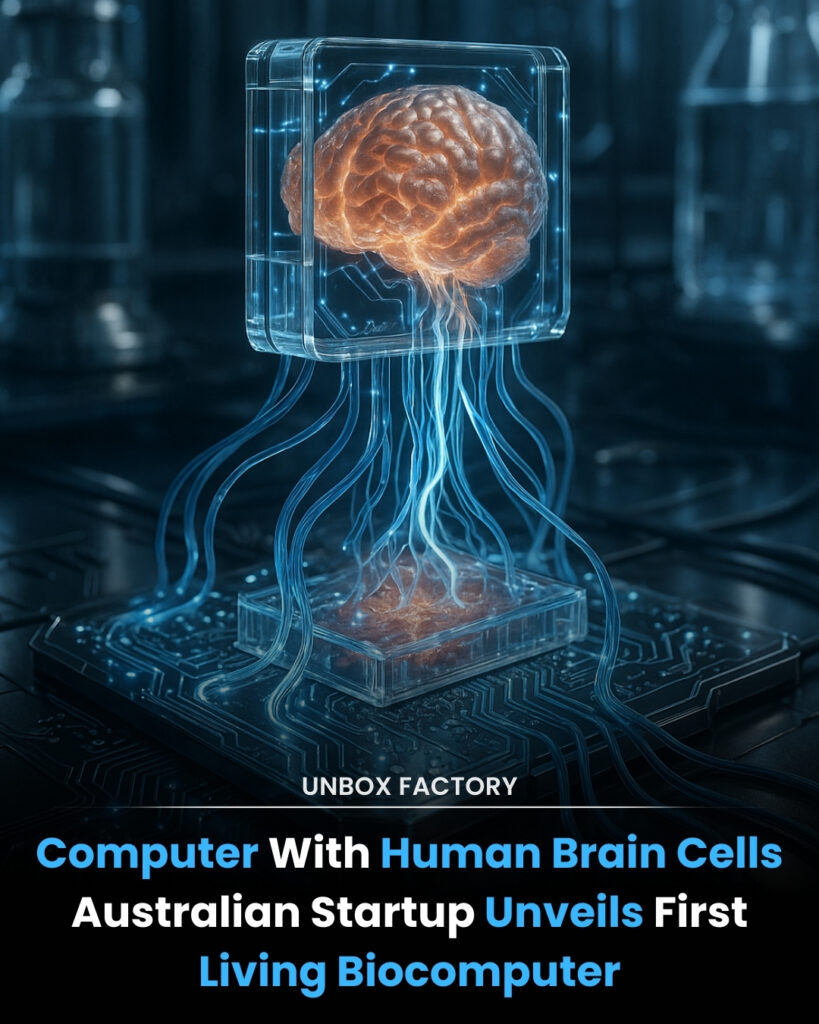
Ever feel like your phone or laptop drains power faster than you can charge it — yet still feels slow? You’re not alone. For decades, we’ve relied on silicon chips and binary logic to run everything from social media to space programs. But now, an Australian startup is turning that model on its head with something straight out of science fiction: a living biocomputer powered by human brain cells.
Yes, you read that right. Instead of metal and microchips, this machine uses living neurons — the same kind of cells in your brain — to process information. And the results are astonishing.
From Silicon to Cells: What Makes This Different
Traditional computers rely on binary logic (1s and 0s) to crunch data. But human neurons are masters of efficiency and adaptability. Researchers at the startup grew lab-based neurons and connected them to electronic systems, creating a hybrid machine capable of learning, adapting, and recognizing patterns far faster than standard computers.
Why It Matters
- Speed: This biocomputer learned to play simple video games faster than cutting-edge AI models.
- Energy Efficiency: Neurons are naturally optimized for efficiency, meaning it uses far less power than traditional chips.
- Adaptability: It can rewire itself — just like a human brain — without needing a complete redesign.
Think of it as upgrading from a calculator to a living, thinking assistant.
Smarter AI, Better Medicine, and Beyond
This isn’t just a cool lab trick. The potential applications are massive:
1. Next-Level Artificial Intelligence
Instead of training huge models on supercomputers that guzzle electricity, future AI systems could combine biological neurons with digital processors for smarter, faster, and greener performance.
Example: Imagine a self-driving car that learns new traffic patterns in real time — not months later through updates.
2. Medical Breakthroughs
Studying living neurons in a biocomputer lets researchers simulate brain diseases more accurately than with silicon chips or animal testing.
Example: Doctors could model conditions like Alzheimer’s or epilepsy directly, leading to better treatments and earlier diagnosis.
3. Game-Changing Simulations
From climate models to financial forecasting, biocomputers could handle complex, unpredictable systems with a level of nuance that traditional computers just can’t match.
The Big Question: Ethics
Of course, this innovation raises serious ethical questions. If a machine is partly “alive,” where does it stop being a tool and start being something more? Could these systems develop a form of consciousness? And who owns a living computer?
As these machines grow more capable, tech companies and governments will need to create guidelines about how they’re built, used, and even retired.
Key Benefits at a Glance
- Unprecedented speed and learning ability
- Huge energy savings compared to silicon-based systems
- Potential to revolutionize AI, medicine, and research
- New ethical frontiers in technology
Quick Recap Checklist
✅ Biocomputer uses living neurons instead of silicon chips.
✅ Learns faster and uses less power than traditional computers.
✅ Could transform AI, healthcare, and simulations.
✅ Raises new ethical and legal questions about “living” machines.
FAQ
Q1: What is a living biocomputer?
A living biocomputer combines biological neurons (grown in labs) with electronic systems to process information like a brain instead of relying on silicon chips.
Q2: Why is it faster than AI models?
Because neurons are inherently designed to learn and adapt efficiently, they outperform traditional digital processors in tasks like pattern recognition and learning new behaviors.
Q3: Will these replace regular computers?
Not anytime soon. They’re still experimental, but they could complement or power the next generation of AI and simulations.
Q4: Are there ethical issues?
Yes. Questions about consciousness, ownership, and the treatment of living systems are now part of the conversation.
Let’s Talk!
This breakthrough feels like the dawn of a new era in computing. A machine that thinks like a brain — but also plugs into digital networks — could reshape everything from your smartphone to your doctor’s office.
What do you think? Would you trust a “living” computer to run your apps, diagnose your health, or drive your car? Drop your thoughts in the comments below — and share this article with your friends to get their take!
Advertisements